
Blue-Collar Church History: Blue-Collar Workers In the Old Testament
Blue-Collar Church History
Blue-Collar Workers In the Old Testament
In order to develop a Godly view of blue-collar men and women, it is important to understand that blue-collar workers are central to Christ’s harvest of souls throughout the centuries. God has consistently used people who weren’t the smartest, the best looking, or the most talented. What God required most from His servants was that they showed up, and gave it their best.
[This is an excerpt from my book, The Blue-Collar Blindspot in it I dig deep into how Christian Media tacitly ignores blue-collar workers and the dignity of human work. I’ll be posting more each week till I’m through the whole book.]
Repeatedly in the Bible, God required nothing more from His servants than to go where He sent them, stand there, and say, “I trust you’ll come through, God.” From the Old Testament to the New Testament and beyond, God has chosen many blue-collar workers to serve him throughout the history of His people. Some you already know, and some you may have overlooked.
Through the course of history shown in the Bible, there was a time when everyone - even kings - farmed and kept animals. Their lives were spent largely outside, and they made by hand every tool they used and every piece of clothing they wore. Getting farther from Noah, this began to change when civilization developed to a level where agriculture and specialized artisans start to appear. The Bible shows us the source of their skill.
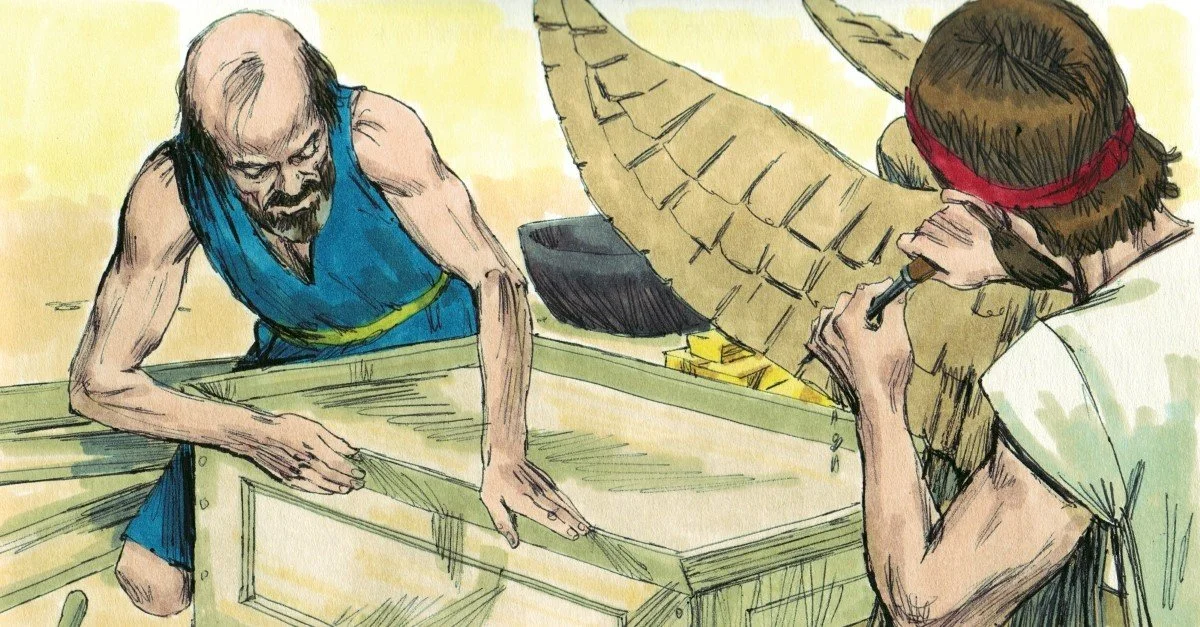
In Exodus, Moses had led the Israelite before the mountain of God. After delivering the commandments, God tells Moses to build the Tabernacle. God chose the workmen by name,AD Bezalel and Oholiab, and personally gave them the skill needed to get the job done.1
God clarified that Bezalel’s skill and craftsmanship came from God Himself when God said, “I have filled him with the Spirit of God” God then called Oholiab by name to be Bezalel’s helper in the work at hand. Besides Bezalel and Oholiab, God also filled many unnamed workers with the skill needed for the work.
God personally gave every detail of the Tabernacle as a prophecy of the Messiah to come. He wanted the Israelites to build the Tabernacle according to his perfect heavenly image. This tent would be the only place the entire two-million strong Israelite nation could come to worship. It would be full of people and animals and sacrifices for 480 years until God allowed Solomon to build the Temple. God showed the importance of blue-collar tradesmen by choosing the best workmen in the camp to work on His Tabernacle. Then He filled them with talent and skill to work and the ability to teach others how to work so they could get the job done right.
Let’s talk about the Temple. It’s often said that “Solomon built the Temple,”2 but did he? It’s hard to imagine a king cutting timbers, laying stones, or digging trenches. Instead, the scriptures state several times that many carpenters and masons came to build the temple. We often forget that Solomon conscripted 30,000 workers, 70,000 people to transport the materials, and 80,000 workers cutting stone in the mountains.3 It seems to me those men built the Temple of God. Not to denigrate the roles Solomon played supervising, organizing, and funding the construction, but he didn’t exactly “build,” the temple himself. Blue-collar workers picked up their tools and turned a pile of random stones and timber into a temple.
Too often the leader is the only one credited with the work of thousands of men. An army of unnamed blue-collar men do the work every time something is built. They worked themselves sore and sweaty every night for years transforming raw stones and metal ore into God's grand Temple. Ezra didn’t build the temple, construction workers did. Herod did not renovate “Herod’s” temple, but contracted a multitude of tradesmen and laborers to perform the work. It’s basically impossible that Herod lifted a finger to do any of the work himself.
I am only pointing out the contribution of the common laborer or tradesman to elevate them to the same standing as the leadership. Yes, without funding there are no materials. Without proper organization the labor is ineffective. Without leadership there is no vision and purpose for the work. At the same time, without skilled and capable workmen nothing gets done. Materials sit in a pile, and plans collect dust. Instead of being ineffective, there are no workers to do anything at all. Without capable workmen to execute the leader’s vision, the pile of materials and plans remain an unfulfilled and hollow image of what could have been.
Leadership and workmanship are two wings on the same bird. You need both to fly, and elevating one over the other causes you to veer out of the straight and narrow way. If God bottles our tears and cares when even a sparrow falls to the ground, then He surely kept a record of every callus and smashed finger that made and fixed each and every temple stone. Let us remember this also.
[This is an excerpt from my book, The Blue-Collar Blindspot in it I dig deep into how Christian Media tacitly ignores blue-collar workers and the dignity of human work. I’ll be posting more each week till I’m through the whole book.]
If you’re interested in assessing your ministry or outreach, to know how blue-collar friendly it is, just pick up my free Ministry Assessment Tool it will allow you gauge what color your collar is and give tailored advice based on your score. Sign up for my Monthly Newsletter and it’s yours.
Join The Crew and support Blue-Collar Bibles Scholar. Every dollar supports the work here and gives more time, for more content. Help keep the lights on and join the member’s only discord and regular LIVE Q&As. I can’t thank you enough.
1Exodus 35:31
21 Kings 6:14
31 Kings 5:13-15