Blue-Collar Church History: Blue-Collar Workers in the New Testament, Christ’s Apostles, The Blue-Collar Blindspot
Blue-Collar Workers in the New Testament, Christ’s Apostles
Moving to the New Testament, we see God use craftsmen in some fascinating ways. The most well-known example is when Jesus chose a humble carpenter to be His father. In Jesus's time, Carpenters seemed not to be the poorest of the poor, but neither were they wealthy. We see this back in the Old Testament when the poor of the land are differentiated from the craftsmen,1 and closer to the first century Dio Chrysostom spoke of carpenters as not highly esteemed or rich, but critical to a city’s defenses.
[This is an excerpt from my book, The Blue-Collar Blindspot in it I dig deep into how Christian Media tacitly ignores blue-collar workers and the dignity of human work. I’ll be posting more each week till I’m through the whole book.]
This is the kind of man Jesus chose to be His dad, and the trade He chose for Himself. Jesus had to learn how to read, count, measure, carve, build, drive nails, and join wood from someone. That someone was Joseph. As a just and moral man who thought of others first, Joseph was just the man for teaching the Son of God how to provide for His family.
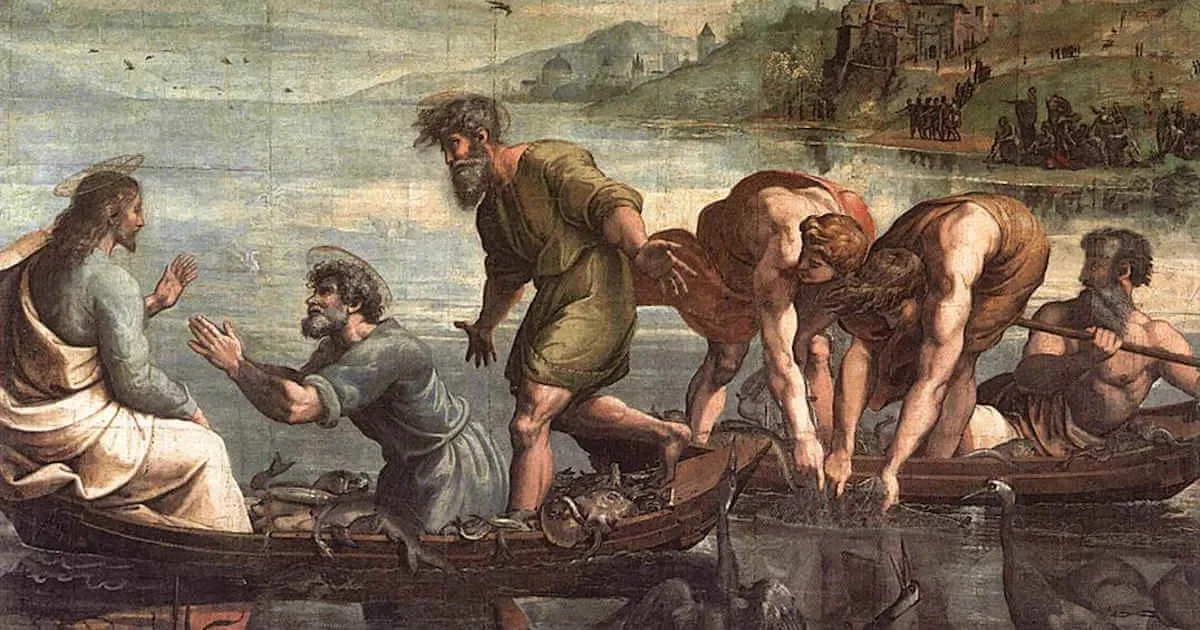
When choosing His apostles, Jesus chose four fishermen. Fishermen are not known for being powerful orators or scholars. They are not renowned for their knowledge of Torah, or critical reasoning skills. They are common men with a common trade, adept sailors on a sea known for sudden and violent storms, and careful craftsmen who had to regularly make and repair their own nets. These men were transformed after just three short years with the Master and the indwelling Holy Spirit. They became men with ironclad arguments who had clearly “been with Jesus,” despite being illiterate and uneducated.2
These fishermen were Andrew, Peter, James, and John, two sets of brothers with powerful destinies. Andrew’s first achievement was proclaiming Jesus as the Christ to no less than Peter himself3. After Jesus’s resurrection, Andrew was in the upper room at Pentecost when God kickstarted His Church. Church tradition relates that Andrew preached in Scythia and went as far Kiev before being martyred in Achaea, in Western Greece.4
Peter was the most vocal and headstrong of Jesus’s disciples and was one of three in His inner circle. He witnessed Jesus’s transfiguration, and received forgiveness for his denials. In the Book of Acts, Peter preaches the first evangelical sermon, which saw 3000 added to the Church in one day. Peter led the Church of Jerusalem alongside James, the brother of Christ. Peter is the one to whom God first revealed His plan for the gentiles. According to Church tradition, Peter later had a significant impact on the Church in Rome, where he was eventually martyred. Peter wrote two canonized letters while in Rome.5
James’s story is perhaps the shortest and saddest of these fishers of men. He was a powerhouse of the early Church for the first half of the Book of Acts. It seems the Church was not even a year old when Herod captured and killed James, the brother of John. He was the first of the Apostles honored with martyrdom.6
John, the author of the Gospel and the Apocalypse is the only Apostle to die of old age. At Christ’s crucifixion, he was given charge over Jesus’s mother, Mary. According to Church tradition, she lived in his house until old age took her.7 John also discipled Polycarp, a famous Bishop and martyr of the early Church. Polycarp then discipled Irenaeus, who was a powerful apologist for the early Church. These men were taught by an illiterate fisherman, who apparently never learned to write until his old age. It is said that John penned some of the worst Greek in the New Testament.
Jesus chose a terrorist,8 a tax collector,9 and a traitor to add to His Apostles; a group of evangelists and preachers He sent out to change the world. A full third of Jesus’s crack team were illiterate fishermen. It’s funny how over a full third of today’s church demographics are blue-collar workers.10
[This is an excerpt from my book, The Blue-Collar Blindspot in it I dig deep into how Christian Media tacitly ignores blue-collar workers and the dignity of human work. I’ll be posting more each week till I’m through the whole book.]
If you’re interested in assessing your ministry or outreach, to know how blue-collar friendly it is, just pick up my free Ministry Assessment Tool it will allow you gauge what color your collar is and give tailored advice based on your score. Sign up for my Monthly Newsletter and it’s yours.
Join The Crew and support Blue-Collar Bibles Scholar. Every dollar supports the work here and gives more time, for more content. Help keep the lights on and join the member’s only discord and regular LIVE Q&As. I can’t thank you enough.
12 Kings 24:14
2Acts 4:13
3John 1:40ff
4MacRory, Joseph. "St. Andrew." The Catholic Encyclopedia. Vol. 1. New York: Robert Appleton Company, 1907. 30 Aug. 2020 http://www.newadvent.org/cathen/01471a.htm.
5Kirsch, Johann Peter. "St. Peter, Prince of the Apostles." The Catholic Encyclopedia. Vol. 11. New York: Robert Appleton Company, 1911. 30 Aug. 2020 http://www.newadvent.org/cathen/11744a.htm.
6Acts 12:2
7Fonck, Leopold. "St. John the Evangelist." The Catholic Encyclopedia. Vol. 8. New York: Robert Appleton Company, 1910. 30 Aug. 2020 http://www.newadvent.org/cathen/08492a.htm.
8Matthew 10:4, Mark 3:18, Luke 6:15
9Matthew 10:3, Luke 5:27
10I go over the numbers in Chapter 5 and Appendix D