
Blue-Collar Church History: The White-Collar Shift, The Blue-Collar Blindspot
White-Collar Shift in the Early Church and Beyond
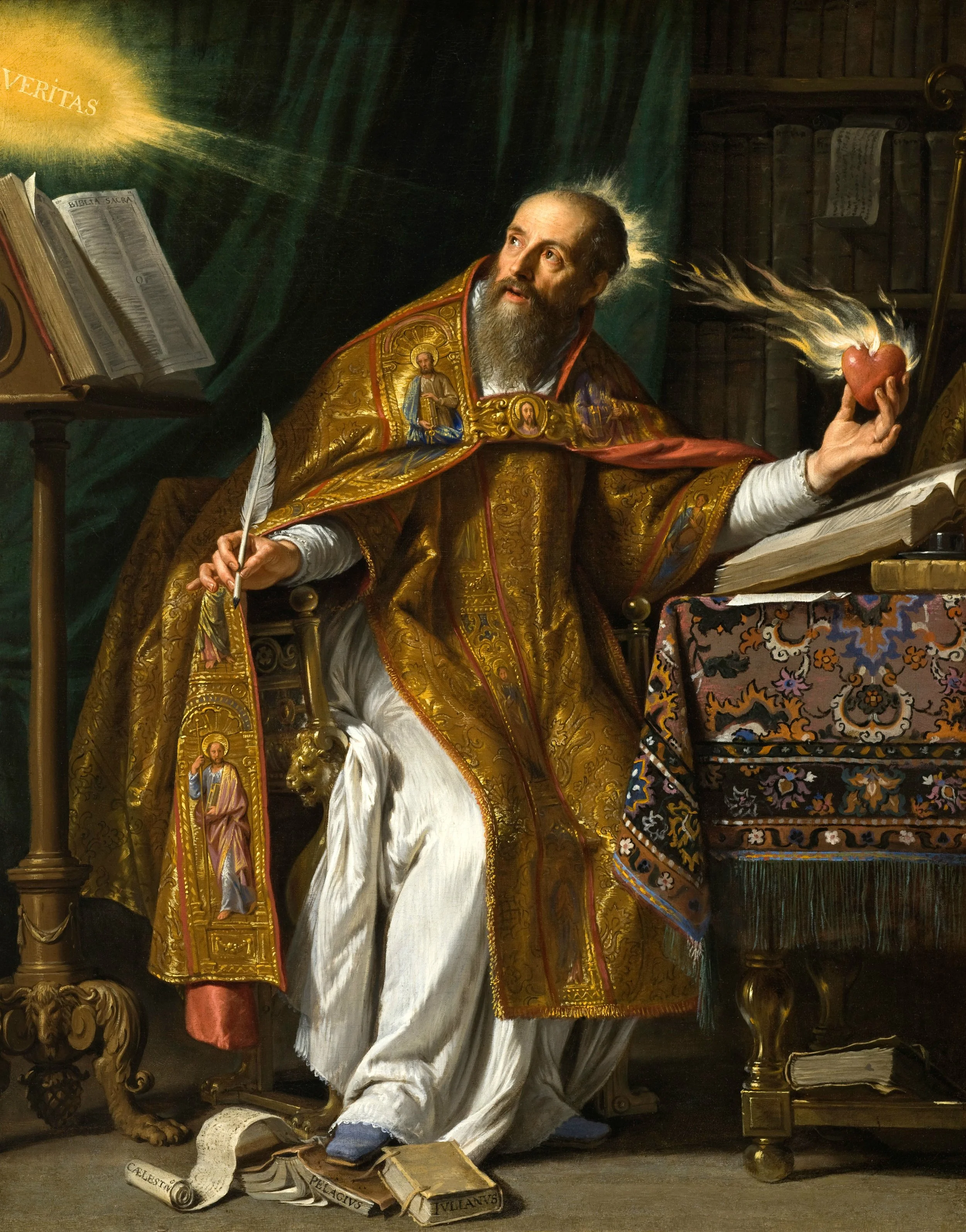
St. Augustine by Philippe de Champaigne
Moving on from the Apostolic Church age to what is often called the early Church, we see a bit of a shift in the nature of the Church’s leadership and most influential Church authors. What was a predominantly blue-collar leadership culture made a gradual shift from the first hundred years into the next hundred. The Church took a marked swing away from common-laborers-turned-street-evangelists and toward the tutored children of aristocracy in selecting scholars and bishops. The most prominent writers all had similar back stories. They were born to wealthy and influential parents who became Christians, and their Christian parents sent them to study with great scholars. Alternatively, they found Christ as young men while drifting from philosophy school to philosophy school. Those young men learned and grew, becoming leading scholars of the early Church. They authored many widely circulated and influential writings, earning them the respect of being called the Church Fathers.
This is an excerpt from, The Blue-Collar Blindspot
The list is long, but here are some of the biggest names in chronological order: Justin Martyr1, Irenaeus2, Clement of Alexandria3, Tertullian4, Origen5, and Eusebius6. These men, along with many others, marked a change in the public face of the Church away from the blue-collar toward a more learned and intellectual presentation. I am not saying the nature of the Gospel changed, but the public face of the Church made the shift toward white-collar leadership. This is important because, in the centuries just after Christ’s death, the Church became relentlessly besieged with intellectually intricate heresies and nuanced attacks from brilliant pagan philosophers. Arians within, and Neoplatonists without.
The Word of God holds true no matter what comes against it. You can also see God prepare His Church by raising up high IQ warriors; armed and ready with quill in hand. The sharpest minds of that era are almost entirely Christian theologians playing intellectual whack-a-mole with heretics and pagan philosophers.
The later philosophers are also Christian authors, who take their own shot at intellectual meditation on scripture. The downside of this prolonged overemphasis on scholarly achievement was an over-intellectualized faith. The further a Christian gets from scripture, the less power his arguments have. This is why Nietzche was able to declare “God is dead.”7 Little did he know, he was not eulogizing the Creator of Heaven and Earth. He was more poking at weaknesses in a “god of the gaps”8 founded in logical necessity that the philosophers had accidentally created. The faith lost the simplicity and power of the Gospel by gradually finding its validity in logic and reason, rather than the Way, the Truth, and the Life.
Another shift begins to occur in the 1700's and 1800's as an industrialized book industry leads to ever easier education of the poorer classes. The reason all of the early Church Fathers were rich kids is because they were the only ones who could afford books, paper, ink, and the time to sit, read, write, and think. Those things were expensive, and the average Joe could not afford to spend time or money on them. Printing presses made books not just affordable, but cheap. This led to a resurgence of simple men digging into their Bibles and following God's hand to preach the Gospel to all creation.
Pilgrim’s Progress was written by a tinker and soldier-turned-pastor named John Bunyan9. William Carey was the father of modern missions and responsible for first translating the Bible into Bengali, Oriya, Assamese, Arabic, Hindi and Sanskrit10. Carey started life as a cobbler. Another famous powerhouse of Christian missions was a humble shoe salesman named Dwight L. Moody, who helped win thousands of souls, founded schools, and established publishing houses11. These are just a few of the blue-collar men who gave God all they had. They realized that was more than enough for the Lord God of Hosts to use for His Glory.
It is important to remember that God has called everyone to a life of service. He will work greatness through everyone that responds to that call. God has a soft spot for the weak, meek, and lowly. He loves using the simple, foolish things of this world to confound the powerful and wise. God has used blue-collar workers throughout history as a powerful contingent to make His name great among the nations.
This is an excerpt from, The Blue-Collar Blindspot
Are you a ministry leader?
Get my Ministry Assessment Tool, free!
Find out how blue-collar friendly your ministry is!
Support the work here and help keep the lights on! Access a member’s only Discord and LIVE Q&A.
1Lebreton, Jules. "St. Justin Martyr." The Catholic Encyclopedia. Vol. 8. New York: Robert Appleton Company, 1910. 30 Aug. 2020 http://www.newadvent.org/cathen/08580c.htm.
2Poncelet, Albert. "St. Irenaeus." The Catholic Encyclopedia. Vol. 8. New York: Robert Appleton Company, 1910. 30 Aug. 2020 http://www.newadvent.org/cathen/08130b.htm.
3Havey, Francis. "Clement of Alexandria." The Catholic Encyclopedia. Vol. 4. New York: Robert Appleton Company, 1908. 30 Aug. 2020 http://www.newadvent.org/cathen/04045a.htm.
4Chapman, John. "Tertullian." The Catholic Encyclopedia. Vol. 14. New York: Robert Appleton Company, 1912. 30 Aug. 2020 http://www.newadvent.org/cathen/14520c.htm.
5Prat, Ferdinand. "Origen and Origenism." The Catholic Encyclopedia. Vol. 11. New York: Robert Appleton Company, 1911. 30 Aug. 2020 http://www.newadvent.org/cathen/11306b.htm.
6Bacchus, Francis Joseph. "Eusebius of Cæsarea." The Catholic Encyclopedia. Vol. 5. New York: Robert Appleton Company, 1909. 30 Aug. 2020 http://www.newadvent.org/cathen/05617b.htm.
7Nietzsche, Friedrich. “125.” The Gay Science, LEIPZIG E. W. Fritzsch, 1887, p. 181.
8This topic is far too large to be treated properly here, but suffice it to say that Newton never proposed a “god of the gaps” but instead said that God is the direct, continual cause of gravity. The phrase actually comes from an author trying to refute the idea that God only hides in the gaps of our knowledge.
9Batson, E. Beatrice. “John Bunyan: The Man, Preacher and Author: Christian History Magazine.” Christian History Institute, 2020, christianhistoryinstitute.org/magazine/article/john-bunyan-the-man-preacher-and-author.
10“Christian History Timeline: William Carey: Christian History Magazine.” Edited by Mark Galli, Christian History Institute, 2020, christianhistoryinstitute.org/magazine/article/william-carey-timeline.
11“Christian History Timeline: Dwight L. Moody and His World: Christian History Magazine.” Edited by Mark Galli, Christian History Institute, 2020, christianhistoryinstitute.org/magazine/article/moody-timeline.