
Blue-Collar Church History: Blue-Collar Workers in the New Testament, Acts to the Epistles, The Blue-Collar Blindspot
Blue-Collar Workers in the New Testament, Acts to the Epistles
The book of Acts lists several more significant blue-collar Christians of the early Church: the Apostle Simon, a tanner, and quite the trio of tentmakers, including the Apostle Paul. Tanners are emblematic of blue-collar work. They took dead animal carcasses and turned them into usable leather, a critical service for other craftsmen who worked with leather. As a first century Hebrew working entirely with dead things, Simon spent more time unclean than clean, and he would've smelled horrible almost all of the time. He would've been at or near the bottom of any social hierarchy. If Simon ever wanted to go to the temple or offer any sacrifice, he would've had to set aside his livelihood for a time. Simon is about as blue-collar as first-century Hebrews come.
[This is an excerpt from my book, The Blue-Collar Blindspot in it I dig deep into how Christian Media tacitly ignores blue-collar workers and the dignity of human work. I’ll be posting more each week till I’m through the whole book.]
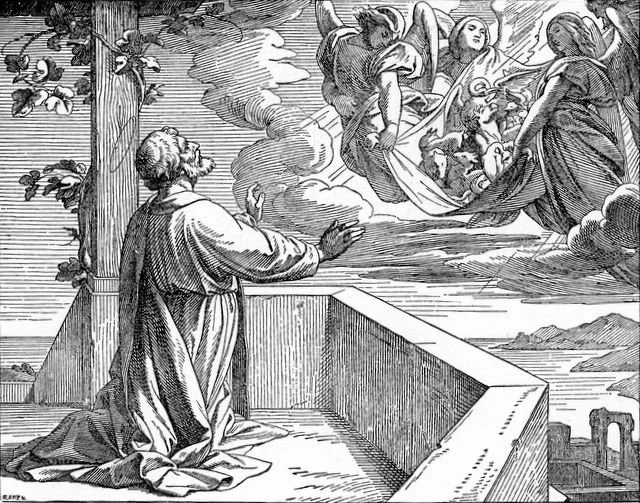
Despite all that, Simon had opened his home to Peter, one of the chief Apostles. It is in Simon’s home that God gave Peter a vision for gentiles coming into the Church. “Do not call unclean that which I have made clean.” God says. It is in Simon’s home that Peter begins learning this lesson. Staying with unclean Simon in his unclean house was only a start for Peter. God used this tanner’s home as the setting for a divine lesson but gave what he did have in service to the Church. It’s like a smellier version of the parable of the “widow’s mite.”
Next we come across Priscilla, Aquila, and Paul himself. In Acts 18 Paul meets a couple of Jews from Rome who just happened to have the same trade he did. You can almost picture Paul walking into the city for the first time. Wandering through the local market place, only to see a Hebrew-run tentmaking booth. He would feel drawn to stop by, talk shop, trade a few tricks of the vocation, and look for the opportunity to evangelize. Imagine his surprise when the Hebrew tentmakers are also fellow Christians. Providence at work!
The Talmud says that any man who doesn’t teach his son a trade teaches him to steal.1 Even though Paul was a Rabbi by occupation, he was still taught a practical trade that he could use to work. Tents were usually made of various hides or skins. Paul would have been cutting patterns, sewing leather, cutting poles, and waterproofing stitches and seams. All of which requires strong, tough hands and a decent amount of know-how. Incidentally, the Bible uses the same word for tent as it does for the Tabernacle in Exodus.
Paul was a tentmaker. This fact creates quite a contrast with the modern conception of Paul. The Apostle most known for his intellect also knew a blue-collar trade. Paul had so much God-given intelligence, modern scholars accuse him of intellectualizing Christianity and infusing it with Platonic philosophy. In reality, he kept things simple and preached in the Spirit and in power. Paul used a blue-collar trade to support his ministry instead of living on support from the Church. He worked hard to be an example to young Christians, working with his own hands to earn his food. Paul was so successful in leading by example that tentmaking has become eponymous for a pastor’s second trade.
Having this trade in common helped deepen Paul's bond with the Christians in Corinth. When it came to sound doctrine and rightly dividing the Word, Priscilla and Aquila were no slouches either. It was just a little while later when they set straight a fiery young man named Apollos. This pair of blue-collar exiles from Rome had the knowledge and skill to correct a man who was “mighty in the Scriptures.”2 These Disciples were so helpful that Paul remembers them in the closing of two of his letters. They also seem to have led a house church in Asia and later in Rome.
There are two more blue-collar men for the already stacked roster. James and Jude were carpenters and Jesus’s brothers. Neither had followed Him until after He died and then rose again. Depending on when their father Joseph died, Jesus would have taught them everything they knew about carpentry. James goes on to be the Bishop of the Church in Jerusalem and author a powerful and concise epistle. Jude, not to be outdone, writes an even more concise epistle and lives to have grandchildren.3 They become Church leaders in their own right, eventually becoming martyrs.
[This is an excerpt from my book, The Blue-Collar Blindspot in it I dig deep into how Christian Media tacitly ignores blue-collar workers and the dignity of human work. I’ll be posting more each week till I’m through the whole book.]
If you’re interested in assessing your ministry or outreach, to know how blue-collar friendly it is, just pick up my free Ministry Assessment Tool it will allow you gauge what color your collar is and give tailored advice based on your score. Sign up for my Monthly Newsletter and it’s yours.
Join The Crew and support Blue-Collar Bibles Scholar. Every dollar supports the work here and gives more time, for more content. Help keep the lights on and join the member’s only discord and regular LIVE Q&As. I can’t thank you enough.
1 Admur 156/2; 306/13; M”A 156/2; 306/13; Kiddushin 29a and 30b; Shabbos 150a; Koheles Raba 9/1; Sifra Emore Parsah 1; Mechilta Rebbe Yishmael Bo 18; Biur Halacha 306 “Ulilamdo”; Omitted from Rambam, Michaber, Rama
2Acts 18:24
3Camerlynck, Achille. "Epistle of St. Jude." The Catholic Encyclopedia. Vol. 8. New York: Robert Appleton Company, 1910. 30 Aug. 2020 http://www.newadvent.org/cathen/08542b.htm.