
The Blue-Collar Bible: Excerpt from The Blue-Collar Blindspot, Blue-Collar in The Old Testament
The Blue-Collar Bible
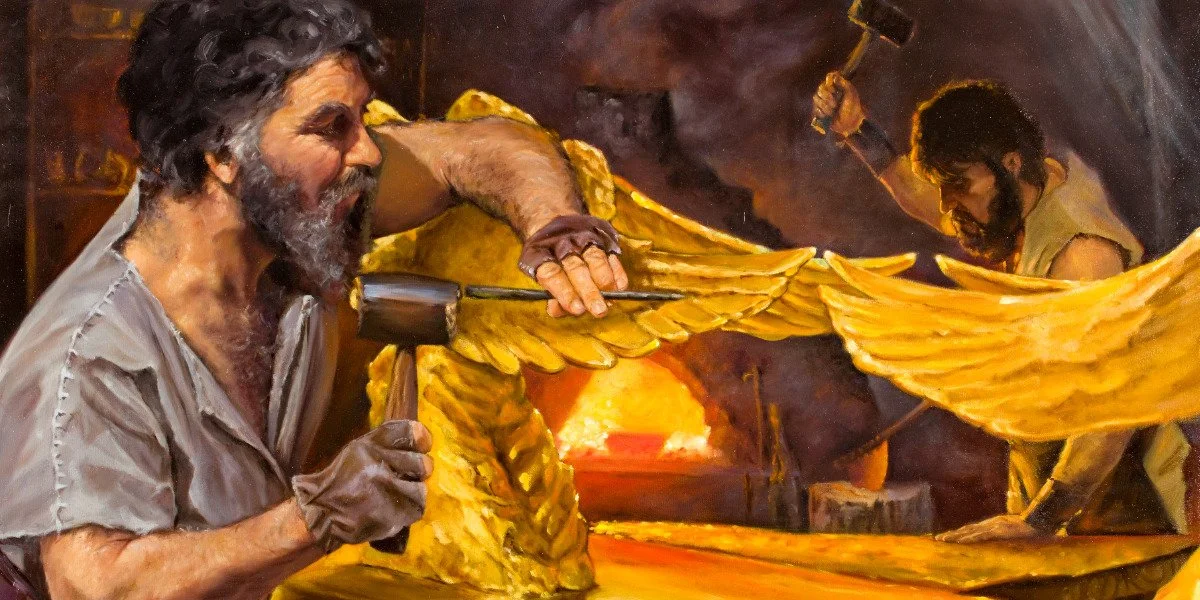
Bezalel and Oholiab working skillfully for the Lord.
Blue-Collar in The Old Testament
God has a soft spot for the blue-collar workers among us. Throughout the Bible, God’s truth is consistently conveyed in the language of the working man. Even in the translations, as early as 300-400BC ancient Hebrew scholars were working to translate the Torah and Prophets into the Koine Greek of the day. The Gospels and every epistle are written in Koine Greek by the time of the Apostles and their disciples. Early on, the entire Canonized Scripture is translated into Vulgar Latin, the common man’s language of the day. Augustine actually mentions multiple Latin translations1 in his writings as early as AD400-ish.
[This is an excerpt from my book, The Blue-Collar Blindspot in it I dig deep into how Christian Media tacitly ignores blue-collar workers and the dignity of human work. I’ll be posting more each week till I’m through the whole book.]
No small while later, John Wycliffe in AD1380ish starts the groundwork on what would become the Geneva Bible in AD1560, (and later the King James in AD1611). The Geneva Bible is the first complete translation of the Bible into Old English, the common tongue of the day. Luther worked in German in AD1522. Jacques Lefèvre d'Étaples in AD1530 translates into the French of his day. In our modern era, there are a multitude of organizations whose sole job is to get complete translations of God’s eternal Word into as many languages as they can.
God also used phrasing, imagery, and situations familiar to Blue-collar workers to communicate the truth. A common laborer will find even the thought structure and the ideas within the written language of the Bible readily accessible.
All over the Old Testament God’s grand and wonderful creation is described with the language of builders. Creation is the “work of His hands."2 God laid the rafters of Heaven. He “founded” Earth3, which is a construction term describing the unknowable care and precision God used to form the world. The way a builder carefully measures and establishes a foundation. The way a carpenter precisely chooses the straightest wood grain, then measures and cuts a rafter.
The Bible readily relates moral lessons in blue-collar terms as well. It refers to living a life strategically oriented toward God’s goals as "working righteousness."4 In Jeremiah, it speaks of wicked rulers building a house with unrighteousness.5 Isaiah and Jeremiah speak of God’s sovereign hand on a life providing guidance and discipline as "a potter and clay."6
The Bible speaks of the intricacy of God’s work with and among the nations in building and working terms. The Assyrian rout of Israel and taking them away into captivity is also the execution of God’s judgement on Israel. God calls this "the work of His hands."7 An entire chapter in the Book of Ezekiel is devoted to his vision, an angel describes the detailed measurements of various buildings and walls of Jerusalem.8 These measurements communicate prophecy and illustrate God’s judgement and mercy.
Then we have the capstone of the Old Testament. God foreshadowing the Messiah. He does this with a stone.9 Builders lay a cornerstone to set the line of the wall in two different directions. They also use the cornerstone as a guide that measures what is level and straight for every other stone in the wall. God uses this simple builder's language to foreshadow the complex mystery of His Messiah. The cornerstone and the Messiah are the foundation and the benchmark.
[This is an excerpt from my book, The Blue-Collar Blindspot in it I dig deep into how Christian Media tacitly ignores blue-collar workers and the dignity of human work. I’ll be posting more each week till I’m through the whole book.]
If you’re interested in assessing your ministry or outreach, to know how blue-collar friendly it is, just pick up my free Ministry Assessment Tool it will allow you gauge what color your collar is and give tailored advice based on your score. Sign up for my Monthly Newsletter and it’s yours.
1of Hippo, St. Augustine. “Chapter 11.” Translated by Select Library of Nicene and Post-Nicene Fathers, Augustine, On Christian Doctrine: Book II, Georgetown University, faculty.georgetown.edu/jod/augustine/ddc2.html.
2Psalm 19:1
3Psalm 104:3, 5
4Isaiah 32:17
5Jeremiah 22:13
6Isaiah 41:25, 64:8, Jeremiah 18:4, 6
7Isaiah 19:25
8Ezekiel 40
9Psalm 118:22, Isaiah 28:16